
Integrated Marketing: Blending Offline and Online for Maximum Impact
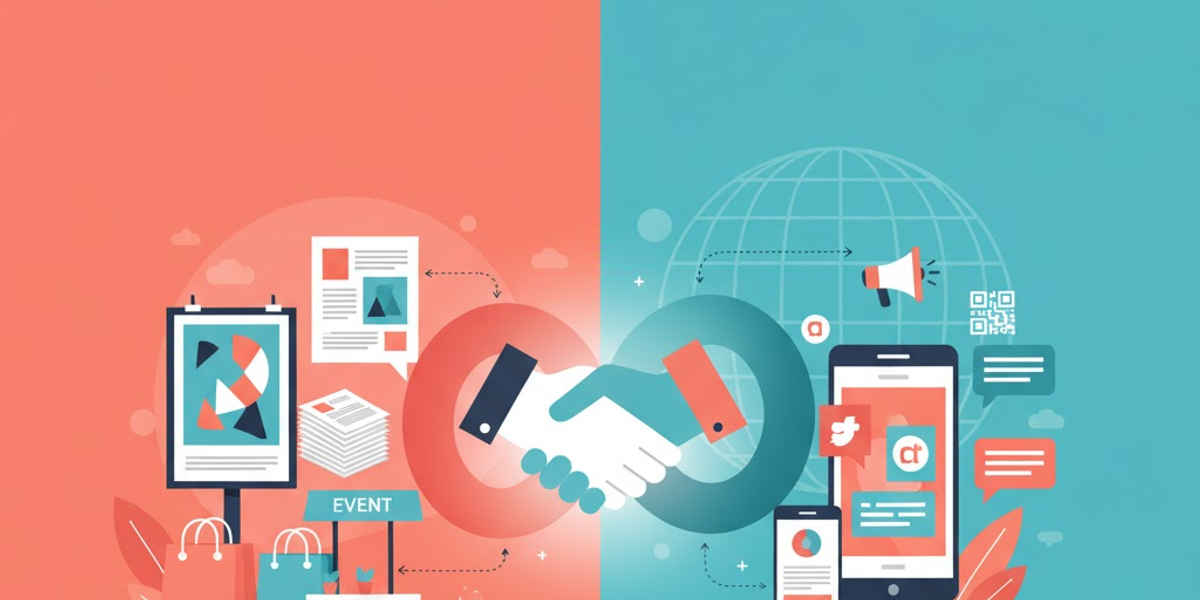
(Because marketing that moves must live in both realms)
Searching for an integrated marketing agency that connects online and offline seamlessly? CupShup delivers unified campaigns that combine digital precision with on-ground impact for maximum brand reach.
In today’s hyper-connected world of modern marketing, your audience doesn’t just scroll, they stroll. They might see a hoarding during their morning commute, watch a reel about the same brand during lunch, and finally make a purchase after an influencer’s recommendation at night. The brands that win in 2025 aren’t just digital-first or offline-dominant, they’re phygital, blending offline online experiences seamlessly.
This is the age of growth marketing, where your campaign lives on the street and on the screen. Where your offline moments spark online movements. And if you’re wondering how to get there, pull up a chair (or cup) because we’re about to spill some seriously insightful chai.
Why the Blend Isn’t Optional, It’s Strategic for Modern Marketing
1. Consumer behavior demands it
Consumers today live in a loop of discovery, online inspiration, offline validation, and back again. According to Google, 80% of shoppers research online before making an in-store purchase. And Harvard Business Review says multi-channel customers have a 30% higher lifetime value than those who interact through just one touchpoint.
This isn’t theory, it’s reality. Think of how often you’ve spotted a quirky billboard, googled the brand, and then ordered from your phone. That’s the power of Online-to-Offline (O2O) marketing campaigns in modern times.
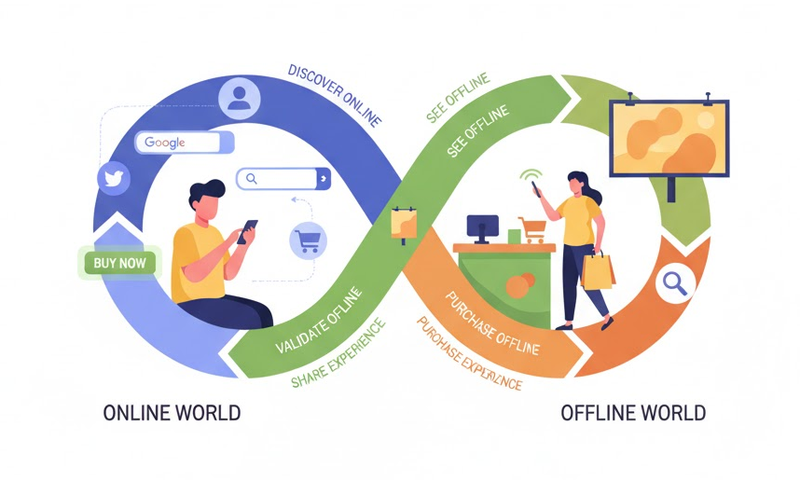
Nerolac Paints nailed this beautifully. They connected digital ads with dealer promotions, helping users find nearby stores through targeted digital prompts. The result? Higher store visits and regional brand recall, achieved with a simple, smart idea.
I remember chatting with Maaz about this, and he said, “The future isn’t online or offline, it’s onlife”. He’s right because that’s where people already live.
2. Synergy is real and measurable in Growth Marketing
Research from InMobi and Sekel Tech shows that integrated O2O marketing campaigns outperform single-channel ones by up to 45% in engagement and conversion. Why? Because emotion builds offline, and conversation continues online.
CupShup, a modern marketing firm, thrives on this synergy. Picture this: a guerrilla activation at a college. Students take photos, tag friends, and post stories. Within hours, what started as a casual street chat becomes a trending digital moment. Sourav always says, “Offline activations are like the trailer. Social media is where the movie runs”. Couldn’t have said it better.
What is Phygital Marketing? The Future of Offline-Online Integration
Phygital marketing is the fusion of physical and digital experiences into a single, continuous brand interaction. The word itself is a mashup of "physical" and "digital," and it perfectly captures where modern integrated marketing campaigns are heading.
Here's what phygital looks like in practice:
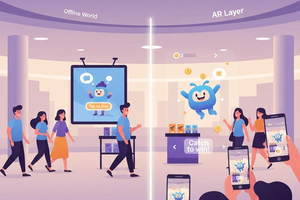
A branded pop-up with QR codes that unlock AR filters or exclusive content on your phone. You're physically present, but digitally connected — and the experience wouldn't work without both.
A sampling campaign where scanning the packaging leads to a personalized landing page with recommendations based on the product you just tried. Offline trial, online conversion.
An event where live interactions are captured, repurposed into reels, and retargeted to attendees via geo-fenced ads the next day. The physical moment is over, but the digital afterlife has just begun.
The brands that think phygital don't see offline and online as separate budgets or separate teams. They see one integrated marketing campaign with multiple touchpoints — and every touchpoint is designed to feed the next.
At CupShup, every campaign we design follows this principle: offline moments should create online momentum. That's not a slogan — it's an operational framework.
The Challenges (and How to Outsmart Them in Omnichannel Marketing)
Even seasoned marketers can trip between the online and offline worlds. Here’s what usually goes wrong and how to prevent it using marketing automation and clear communication.
- Attribution anxiety: Tracking who came from where feels like solving a Rubik’s cube blindfolded. Fix it by using unique QR codes, UTM-tagged URLs, or offline redemption codes that loop back into your CRM.
- Message mismatch: If your poster says “Flat 50%!” and your Instagram ad says “Limited 30%”, people will question your credibility. Keep messaging consistent everywhere.
- Data silos: If your activation data doesn’t sync with your digital dashboard, you’re missing key insights. Always integrate POS data, lead forms, and analytics into one system.
- Overproduction trap: Don’t go national before proving resonance. Test in one city or format first.
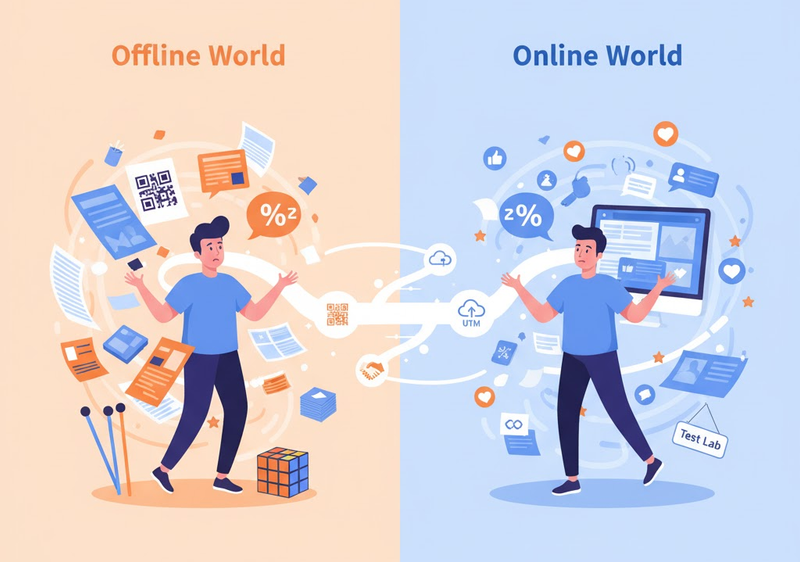
When I was reviewing a campaign with Divyanshu and Surya, they reminded me that data gaps are like missing puzzle pieces. You can’t see the whole picture unless every bit connects. They’re the ones who’ll track every impression to conversion, down to the last chai coupon.
Pro Tip: Build a feedback bridge between your on-ground and social teams. Real-world reactions meet digital insights. Together, they make optimization faster and smarter.
Omnichannel Marketing Strategy: CupShup's 5-Step Framework for Cross-Channel Campaigns
An effective omnichannel marketing strategy doesn't happen by accident. It requires a framework that connects every channel — social, email, on-ground activation, paid ads, and content — into a single narrative that moves the customer forward. Here's ours.
Here’s our 5-step model to blend offline energy with online amplification, a formula brewed to perfection over hundreds of marketing campaigns.
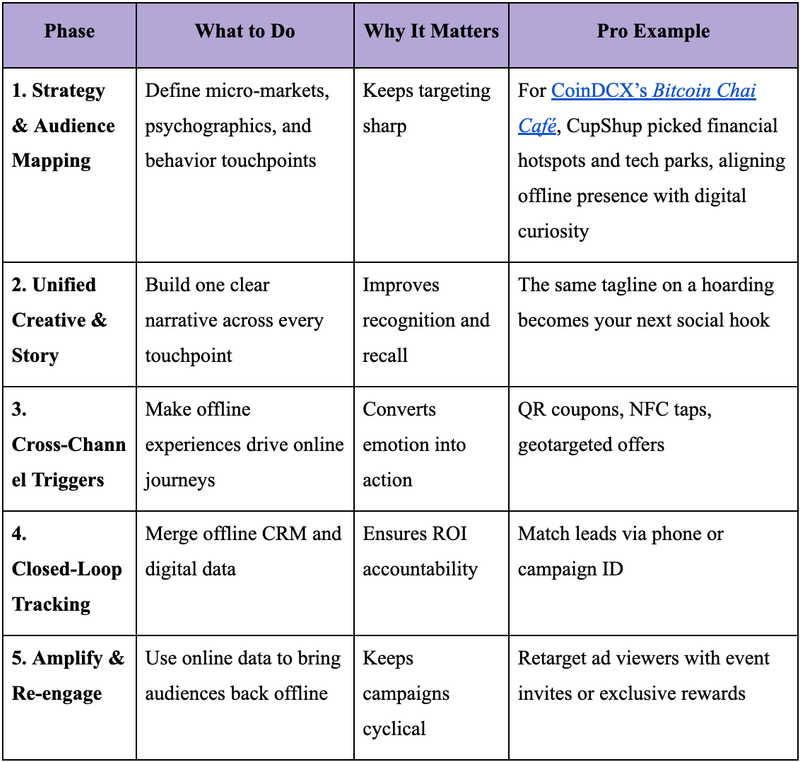
Yuvana once joked during a brainstorm, “We’re basically making marketing boomerangs - throw it offline, it comes back online”. Honestly, that’s exactly how it works.
Expert Hack: Never close a loop completely. Great campaigns behave like Möbius strips, flowing endlessly between physical and digital touchpoints.
Evidence in Action - Fantastik’s Raise The Bar Case Study in Modern Marketing
Brand: ITC Sunfeast FantastikAgency: CupShupConcept: Turn heartbreak into a headline.
During Valentine’s Week, when lovebirds ruled the marketing skies, Sunfeast Fantastik decided to speak to the ones left out: the singles. Their “Raise the Bar” campaign redefined Valentine’s Day with self-love and closure at its heart.
A striking ‘Dump Truck’ activation invited people to literally dump their ex’s stuff (hoodies, letters, and memories) in exchange for chocolate hampers. It was real, raw, and ridiculously viral.
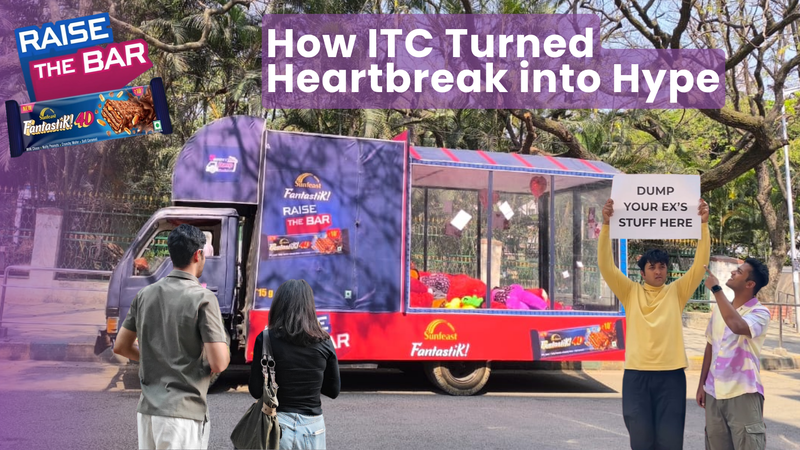
Results: 15 crore+ digital impressions, 10 lakh+ offline engagements, and over 5,000 UGC posts. Fantastik became the voice of confident singlehood.
When I asked Sourav why it worked so well, he said, “We gave heartbreak a PR plan”. He wasn’t wrong. It was bold, funny, and deeply human.
Why It Worked
- Untapped Audience: Singles, a huge yet ignored audience, finally had a brand that spoke their truth.
- Built for Sharing: Every activation was designed for easy posting - from lighting to signage to moments.
- Authenticity Over Gloss: Real stories beat picture-perfect scripts every time.
Pro Takeaway: Every offline prop should double as a content magnet. Fantastik’s dump truck wasn’t just a prop, it was a stage for stories.
Cross-Channel Marketing Tactics: Advanced Tips from 400+ Campaigns
1. Think “Phygital Funnels”
A funnel isn’t linear anymore. People might see a digital teaser, attend a live event, get retargeted online, and purchase through WhatsApp commerce. Map behavioral triggers across both spaces. Combine these insights with artificial intelligence in marketing to make smarter predictions about customer intent.
2. Use Micro-Influencers for Local Scale
Celebs bring reach, but local creators bring trust. Pair offline activations with regional nano-influencers to drive hyperlocal buzz that feels genuine. This is one of the best omnichannel marketing examples in modern practice.
3. Geo-fence Smartly
To measure conversion lift, drop digital ads around event zones or sampling sites. Platforms like Google Ads and Meta let you target by radius - ideal for tracking campaign impact.
Read next: Integrated Marketing Communications (IMC): Complete Guide..., From Streets to Screens: 7 Ways to Turn On-Ground Campaig..., and How to build a 360° campaign brief (templates included).
4. Merge CRM + Offline Redemption
For any activation, collect first-party data via digital opt-ins and sync it with your analytics. That’s how you connect real-world action to measurable outcomes using marketing automation.
5. Design for Shareability and Ambient Advertising
Add irresistible moments like props, witty signboards, or AR filters that beg to be shared. Nothing scales faster than user-generated buzz. Use ambient advertising elements to make people pause, smile, and post.
Sidharth often says, “If a QR scan doesn’t feel like a dopamine hit, it’s not done right”. Tech should make people smile, not sigh.
360 Degree Marketing: Why Integrated Campaigns Outperform by 45%
The data is clear: integrated marketing campaigns that coordinate across offline and online channels outperform single-channel campaigns by up to 45% in engagement and conversion.
That's because 360 degree marketing — the approach of surrounding your audience with coordinated touchpoints — exploits a psychological truth: people need 7-12 brand touchpoints before they trust you enough to act.
Why Brands Choose CupShup as Their Integrated Marketing Agency
CupShup isn't just another integrated marketing agency — we bridge the gap between digital and physical marketing using AI-powered campaign orchestration. From hyperlocal activations to national digital campaigns, our integrated approach has powered 10,000+ campaigns across 300+ cities with measurable results at every touchpoint.
Think about the Fantastik "Raise the Bar" campaign covered earlier in this blog. A consumer might: see the Dump Truck on the street (offline awareness), see a friend's Instagram story about it (social proof), see a retargeted ad the next day (digital reminder), click through to the campaign page (consideration), and engage with the brand on social (relationship building).
Five touchpoints. Three channels. One unified story. That's 360 degree marketing in action.
For brand managers planning their next integrated marketing campaign, the takeaway is simple: don't allocate budget by channel. Allocate budget by customer journey stage. Then assign the right channel to each stage.
Benchmark Omnichannel Marketing Examples You Should Know
- Nerolac Paints: Unified dealers and digital audiences with location-based targeting.
- CoinDCX Bitcoin Chai Café: Turned crypto curiosity into chai-time conversations, making finance feel friendly.
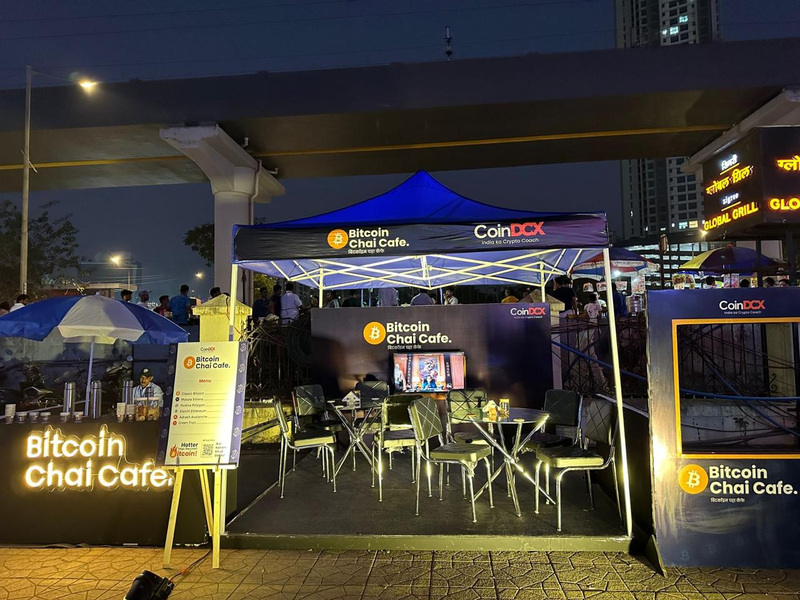
Each example shows how local relevance, cultural timing, and digital storytelling can make your campaign stand out in growth marketing.
Your Blended Campaign Checklist for Offline Online Success
- Hook them offline, nurture them online.
- Create reasons to scan, click, or share.
- Keep your tone and visuals consistent.
- Track every touchpoint.
- Keep the story alive; retarget, remix, and reengage.
Final Thoughts: Where the Magic Lives in Modern Marketing
Offline gives you touch, online gives you talk. Together, they create trust.
The secret isn’t just integration, it’s intention. You’re not merging channels; you’re choreographing experiences.
At CupShup, we call it Marketing That Moves, where every chai cup, street activation, or QR scan can spark a viral story. Because when offline experiences meet online conversations, brands don’t just get noticed, they get remembered.
And as I like to say when we wrap a successful campaign - “Bas ab ye chal gaya!”
Because when it moves, it really moves.
Ready to Blend Your Next Marketing Campaign?
Let’s turn your next offline online moment into an omnichannel success story. Reach out to CupShup (your potential creative marketing firm ;) and let’s create marketing that doesn’t just run - it moves.
What is online to offline (O2O) marketing?
Online to offline marketing is a strategy where digital channels (social media, search ads, email) drive consumers to take action in the physical world — visiting a store, attending an event, or redeeming an in-person offer. CupShup designs O2O marketing campaigns that bridge this gap using QR codes, geo-targeted ads, and creator-led activations.
How do you build a cross-channel marketing strategy?
Start with one question: what's the customer journey? Map every touchpoint from first awareness to final conversion. Then assign the right channel to each touchpoint — social for discovery, email for nurture, on-ground for trial, digital for retargeting. Use shared tracking (UTMs, QR codes, CRM sync) to connect the dots across channels. That's cross-channel marketing in practice.
Get Started with CupShup Today
Ready to see real results? Book a Free Integrated Marketing Strategy Call → Join 500+ brands that trust CupShup.
50 Integrated Marketing Campaign Ideas
The complete playbook with campaign frameworks, budget templates, and measurement guides for Indian brands.
Instant download + email copy. No spam, ever.
Integrated Marketing FAQ: Blending Offline and Online for Maximum Impact
What is integrated marketing and how does it blend offline and online strategies?
Integrated marketing is a strategic approach that unifies all marketing channels and touchpoints to deliver consistent brand messaging across offline and online platforms. This integrated marketing strategy ensures that traditional advertising, digital campaigns, events, and social media work together seamlessly, creating a cohesive 360 marketing experience that maximizes brand impact and customer engagement.
How does an effective integrated marketing strategy maximize business impact?
An effective integrated marketing strategy maximizes impact by creating synergies between offline and online channels, amplifying message reach and frequency. This 360 marketing approach ensures consistent brand experience across all touchpoints, improves customer journey continuity, and provides comprehensive data insights that inform better decision-making and budget allocation across channels.
What are the key benefits of 360 marketing for modern brands?
360 marketing benefits include increased brand awareness through multi-channel exposure, improved customer experience through consistent messaging, and enhanced ROI through channel optimization. This integrated marketing approach enables brands to reach customers at multiple touchpoints, creating stronger brand recall and driving higher conversion rates through strategic offline and online integration.
How can brands successfully implement integrated marketing across different channels?
Successful integrated marketing implementation requires unified messaging strategies, coordinated campaign timing, and consistent brand identity across all channels. Brands need integrated marketing strategy that includes shared customer data, cross-channel analytics, and coordinated content creation that works for both offline and online platforms while maintaining brand authenticity and relevance.
Essential Tools for Integrated Marketing and 360 Marketing Success
HubSpot
Marketing PlatformComprehensive integrated marketing platform for unified campaign management and analytics
Learn More →Buffer
Social Media ManagementSocial media management platform that integrates seamlessly with offline marketing campaigns
Learn More →Mailchimp
Email MarketingEmail marketing automation that supports integrated marketing across all customer touchpoints
Learn More →ActiveCampaign
Marketing AutomationCustomer experience automation platform for integrated marketing strategy execution
Learn More →Hootsuite
Social Media ManagementSocial media management solution for 360 marketing campaigns and cross-channel coordination
Learn More →Zapier
Automation PlatformMarketing automation connector that enables integrated marketing workflows across platforms
Learn More →Integrated Marketing Services: 360 Marketing Strategy Implementation
Explore how CupShup's integrated marketing expertise helps brands create powerful 360 marketing strategies that seamlessly blend offline and online channels for maximum impact.
Experiential Marketing Services
Offline brand experiences that integrate with digital campaigns for comprehensive 360 marketing impact
Performance Marketing Services
Data-driven online campaigns that complement offline marketing for integrated marketing strategy success
Brand Activation Services
Integrated marketing campaigns that activate brands across offline and online touchpoints
Digital Integration Services
Technology solutions that connect offline experiences with digital marketing for seamless 360 marketing
Content Strategy Services
Unified content creation that works across offline and online channels for integrated marketing strategy
Swiggy Quick Commerce Case Study
How integrated marketing transformed hyperlocal brand activation across offline and online channels
MediBuddy Health Tech Case Study
360 marketing approach that connected offline health initiatives with digital engagement
The Aashram OTT Campaign
Integrated marketing success that blended traditional promotion with digital amplification
Explore CupShup Services
Brands that read this article also explored these services.
Integrated Marketing Agency
360-degree campaigns that connect offline activations with digital amplification for compounded ROI.
Learn more BrandBrand Strategy & Positioning
Brand architecture, positioning frameworks, and messaging strategy for market differentiation.
Learn more ActivationBrand Activation Agency India
India's leading brand activation agency, 400+ campaigns, pan-India reach, real-time dashboards.
Learn moreCuppa CS
Digital Marketing Expert specializing in AI-powered marketing tools and automation. Cuppa CS helps brands leverage cutting-edge technology to optimize their digital presence and drive customer engagement.
Related Stories
Go Deeper with Our Free Guides
Comprehensive, in-depth marketing guides created by CupShup's experts.
The Ultimate Guide to Brand Activation
Everything you need to know about bringing your brand to life, strategies, examples, and frameworks.
The Ultimate Guide to Digital Marketing
Master every channel in the modern digital marketing ecosystem, from SEO to paid media.
The Ultimate Guide to SEO
The definitive guide to search engine optimization, on-page, technical, and link building strategies.